
Interflex 1.5
A graphical client for requesting and reading material over UUCP.
Borland C, BGI graphics, Waffle UUCP · for EduNET
Author’s notes
Amir Husain · software I wrote
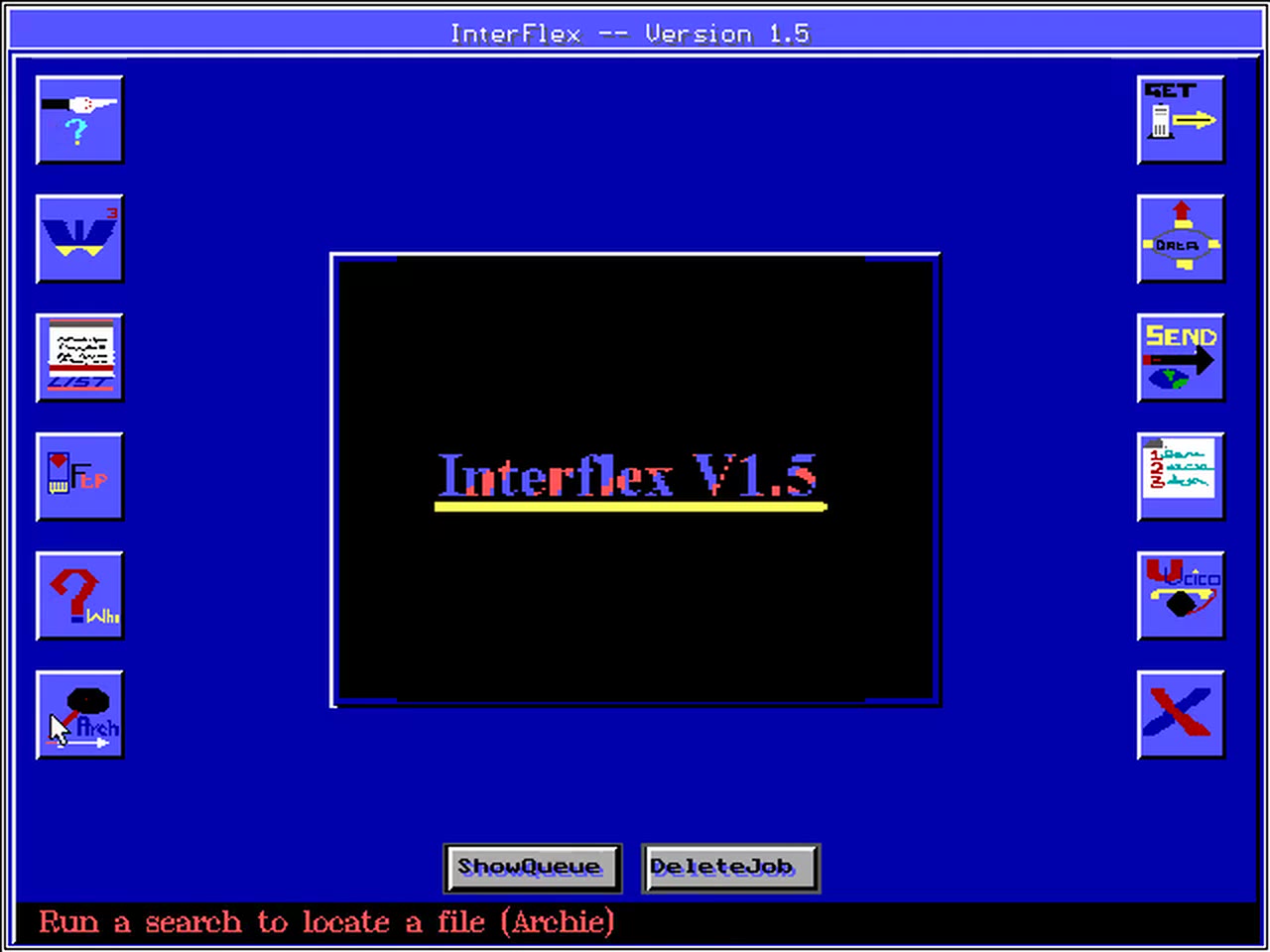
I wrote Interflex to request material while connected and read it after hanging up. The service I used in Pakistan relied on UUCP exchanges. The program provided an index, a download queue, and viewers for returned files. Finger, Whois, Archie, FTP, and web-page requests could be sent by email and collected on a later call.
Reading the demonstration
Browse the index, queue files and a Finger request, then start the exchange. Once it finishes, open the returned text and picture files.
About this recording and recovery
Waffle and the modem are gone, so the dial-out in this recording is a stand-in that plays the session Interflex expected and delivers the queued files from a folder standing in for EduNET. Everything else on screen is the 1996 program: the index, the queue, the Finger dialog, the Q editor it hands text to and the QPEG viewer it hands a JPEG to.
Archive record
- Author
- Amir Husain
- Date
- c. 1996
- Environment
- Borland C, BGI graphics, Waffle UUCP · for EduNET
- Reference
- ATX-SW-INTERFLEX
The software archive preserves dates, implementation notes, and surviving source material. Contact the museum to explore the program’s documentation.
A call to EduNET
Queue a request, run uucico, and watch the files arrive. Then read them with cat or open the picture in xv. The buttons enter the commands for you; the prompt also accepts typing.
LAHORE.GIF · collection demonstration image
Interactive reconstruction of a UUCP exchange in a period Unix desktop. The recordings above preserve Interflex’s DOS interface and its Q editor and QPEG viewers.