
Steven Spielberg's Jurassic Park Indigo
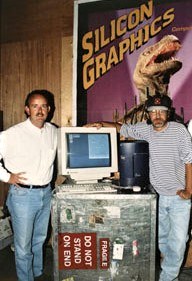
An SGI Indigo Elan presented by Silicon Graphics to Steven Spielberg during the production of Jurassic Park.
The machine behind the story
This Indigo Elan carries the inscription “The Spielberg Edition, 1/1.” A surviving handover photograph, service labels, and collection records connect it to Silicon Graphics’ presentation of the machine to Steven Spielberg during the production of Jurassic Park.
Before the film reached theaters, Silicon Graphics presented Spielberg with an Indigo Elan. The machine in this collection still carries its inscription, service labels, and the photographic record of the handover.
The object is preserved as a piece of film and computing history. Its significance is the documented passage from Silicon Graphics to Spielberg and the fact that the machine remains identifiable today.
The detailed record brings together the handover photograph, close views of the case, and the inscription “The Spielberg Edition, 1/1.”
Amblin, ILM, and the moment the image became believable
In 1993, Jurassic Park made a computer-generated animal feel present in a photographed world. Its dinosaurs had weight. Their feet met the ground; sunlight caught their skin. Spielberg combined Stan Winston’s physical creatures with ILM’s digital work, choosing the technique that made each shot convincing. The result changed what filmmakers could ask an image to do.
Amblin Entertainment was the production company around Spielberg’s film. Industrial Light & Magic supplied the digital dinosaurs. Silicon Graphics supplied the computing platform, and also helped Amblin create the park’s on-screen control room. The Indigo sits at the meeting of those worlds: a tool for making images and an object through which an audience imagined the future.
SGI’s contemporary announcement records a loan of nearly a million dollars in workstations to Amblin and four months of technical support. The equipment included Indigo and Indigo Elan desktops as well as larger Crimson and 4D systems. Engineers helped synchronize displays with film cameras and get their colors right. This was a collaboration between people who understood cinema and people who understood the machinery that could put a new kind of image on screen.
The collection’s Indigo Elan carries a more personal connection: “The Spielberg Edition, 1/1.” The photograph of Steven Spielberg receiving it from SGI’s Harry Pforzheimer turns a manufacturer’s history into the history of this particular object. The inscription, enclosure, service labels, and handover photograph belong together. A workstation that might otherwise be read as processor, memory, and graphics becomes a surviving link to one of cinema’s decisive technical changes.
Sources: Amblin’s film history; ILM on creating the dinosaurs; SGI’s June 1993 announcement, preserved by sgistuff; collection inscription and handover photograph.
“It’s a UNIX system! I know this!”
Lex Murphy’s recognition of the park’s computer became one of the most repeated lines in computing culture. A child sits down at an intimidating workstation, recognizes its world, and knows what to do. For people who grew up learning machines by exploring them, the appeal is immediate.
The three-dimensional landscape on her screen was SGI’s fsn, pronounced “fusion”: an experimental File System Navigator for IRIX, SGI’s Unix. Files and directories became a landscape that could be flown through. The scene put a real piece of exploratory interface design into popular memory. The Indigo in this collection gives that memory a physical scale: the case, the screen, and the Unix environment behind the line.
The story continues in Austin. Four years after Jurassic Park, Iguana Entertainment’s Turok: Dinosaur Hunter put players inside a world of dinosaurs. SGI workstations helped developers build that world. Follow the Turok Indy to see cinema’s digital possibilities become something a player could move through.